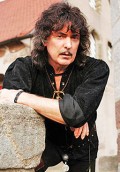

Ritchie Blackmore, the co-founder of Deep Purple and architect of Rainbow and Blackmore’s Night, has been honoured with the National Guitar Museum’s Lifetime Achievement Award, recognising more than six decades of influence on the evolution of the electric guitar.
by Paul Cashmere
The National Guitar Museum has announced that Ritchie Blackmore is the 2025 recipient of its annual Lifetime Achievement Award, placing him among a select group of players whose work has altered the course of modern music.
Blackmore becomes the sixteenth artist to receive the honour, joining past recipients including B.B. King, Jeff Beck, Bonnie Raitt, Jose Feliciano and Tommy Emmanuel. The award recognises artists whose lifetime contribution has significantly advanced the cultural legacy and historical development of the Guitar.
In announcing the honour, museum executive director HP Newquist cited Blackmore’s singular impact across multiple eras and genres. Best known as the driving creative force behind Deep Purple and later founder of Rainbow, Blackmore first cut his teeth as a London session Guitarist in the early 1960s. His credits from that period include recordings with The Outlaws and a raft of British pop and R&B acts, work that sharpened a technique already shaped by classical study and blues phrasing.
Blackmore responded with characteristic understatement. “I’m rather thrown by the magnitude of this honourable award,” he said. “I am grateful to accept this award and this recognition.”
Born Richard Hugh Blackmore in Weston-super-Mare in 1945, he was raised in Middlesex and given his first Guitar at 11, on the condition he learn to play properly. A year of classical tuition laid the groundwork for a style that would later fuse baroque melodicism with high-volume rock dynamics. After leaving school at 15 and working briefly as an apprentice radio mechanic near Heathrow Airport, he studied electric Guitar with noted session player Big Jim Sullivan and began taking on professional work.
By 1968, Blackmore had joined the band that would become Deep Purple. Their 1970 breakthrough album In Rock shifted the group’s direction from psychedelic experimentation into the harder-edged territory that would help define heavy rock in the decade to follow. The riff Blackmore wrote for Smoke On The Water has since become one of the most recognisable motifs in rock history, a rite of passage for generations of Guitarists.
Across landmark albums including Machine Head and Burn, Blackmore’s playing combined blues scales with dominant minor modes and rapid, classically inflected runs. His use of fourth-based riffs became a template for hard rock and heavy metal, influencing countless players who followed.
After departing Deep Purple in 1975, he formed Rainbow, initially with vocalist Ronnie James Dio. Albums such as Rising and Down To Earth broadened his palette, introducing medieval textures and, later, a more streamlined melodic approach. Rainbow’s catalogue has sold an estimated 28 million albums worldwide, underscoring Blackmore’s commercial as well as artistic reach.
Deep Purple’s reunion in the mid-1980s produced Perfect Strangers and reaffirmed the enduring chemistry of the Mark Two line-up. In 2016, Blackmore was inducted into the Rock and Roll Hall of Fame as a member of Deep Purple, cementing his status within the canon of modern rock.
In the late 1990s, Blackmore pivoted again, forming Blackmore’s Night with Candice Night. Their debut Shadow Of The Moon introduced a Renaissance-inspired folk rock direction that leaned heavily on acoustic instrumentation and period themes. The duo has since released eleven studio albums, most recently Nature’s Light in 2021, cultivating a dedicated global audience through intimate live performances rather than large-scale touring.
The National GUITAR Museum describes itself as the only institution devoted exclusively to the history, evolution and cultural impact of the Guitar. Its touring exhibitions have appeared in more than 60 museums worldwide and will form the foundation of a permanent home in the coming year.
Blackmore’s recognition in 2025 places him in a lineage that stretches from Delta blues pioneers to contemporary virtuosos. For an artist who has moved from hard rock arenas to Renaissance fairs, from Stratocaster-driven amplification to acoustic balladry, the award acknowledges both the breadth of his catalogue and the distinct voice that runs through it.
In a career marked by innovation, volatility and reinvention, Blackmore’s contribution remains unmistakable. The riffs endure, the influence persists, and the instrument he helped redefine continues to carry his imprint.
Stay updated with your free Noise11.com daily music news email alert. Subscribe to Noise11 Music News here
Be the first to see NOISE11.com’s newest interviews and special features on YouTube. See things first—Subscribe to Noise11 on YouTube
Follow Noise11.com on social media:
Bluesky
Facebook – Comment on the news of the day