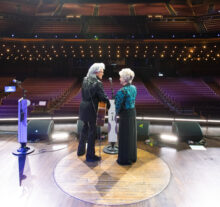

Connie Smith has paid tribute to John Anderson following his reported sudden death, recalling a final conversation and embrace at Nashville’s Country Music Hall of Fame Medallion Ceremony just days earlier.
Connie Smith has shared a personal tribute to John Anderson, remembering the country singer with affection after the pair met at Nashville’s Country Music Hall of Fame Medallion Ceremony shortly before his reported death at 71.
Connie’s tribute centred on the significance of their final encounter, a brief moment of conversation and a hug that has taken on new meaning following the news of Anderson’s passing.
“I’m so sad to hear of the sudden passing of John Anderson after just seeing him at the Hall of Fame induction on Sunday,” Connie Smith said. “I’m so thankful I got to talk with him and give him a hug one last time. He was a great singer and I loved him.”
The message offered a personal perspective on the loss of an artist whose distinctive voice and commitment to traditional country music earned him a lasting place in Nashville’s musical community.
John Anderson’s reported death followed his attendance at the Country Music Hall of Fame’s 2026 Medallion Ceremony, held on 18 October. The event honoured Tim McGraw, The Stanley Brothers and songwriter Paul Overstreet. Anderson had been inducted into the Hall of Fame in 2024, while Connie Smith received the honour in 2012.
Their meeting brought together two artists whose careers reached their commercial peaks in different decades but whose reputations have endured well beyond their chart successes.
Connie Smith established herself as one of country music’s most respected vocalists during the 1960s, earning recognition for her expressive delivery and ability to communicate the emotional detail of a song.
She joined the Grand Ole Opry in 1965, beginning a long association with the institution that has remained central to her career. Her recording of Once a Day became a defining early success, reaching number one on the Billboard country singles chart in 1964 and establishing Smith as a major new voice in the genre.
Her standing among fellow performers has been equally enduring. Dolly Parton has publicly praised Connie Smith’s singing, while George Jones also regarded her as one of country music’s outstanding female vocalists.
John Anderson followed a different path to prominence. Born in Apopka, Florida, he moved to Nashville as a young performer and developed a sound shaped by traditional country, Southern musical influences and an unmistakable vocal style.
His breakthrough came in the late 1970s and early 1980s, when he became an important figure in the new traditionalist movement. At a time when country music was navigating changing production styles and commercial influences, Anderson maintained a sound that was recognisably his own.
The connection between the two singers was not built around a recording collaboration. They never released a duet together. Their shared standing instead reflected the respect they earned independently within the same musical community.
John Anderson’s 1982 hit Swingin’ became one of the signature recordings of his career. Its playful delivery, distinctive vocal phrasing and memorable arrangement helped establish him as one of the era’s most recognisable country performers.
The same year, Wild & Blue further cemented his reputation. Other major hits included Black Sheep, Straight Tequila Night and Money in the Bank, songs that demonstrated his ability to move between traditional country storytelling and more contemporary Nashville production without losing his identity.
His career experienced another significant commercial moment with the 1992 album Seminole Wind. The title track became one of his best-known recordings, connecting environmental themes with the storytelling traditions of country music.
Anderson continued recording and performing long after his initial chart successes. His 2020 album Years, produced by Dan Auerbach and David Ferguson, introduced his work to listeners beyond the traditional country audience. The record also reinforced the enduring appeal of his voice and songwriting.
The subsequent tribute project Something New: A Tribute to John Anderson reflected the esteem in which his catalogue was held by other musicians. Younger artists found material in his songs that could be reinterpreted without losing their original character.
His influence crossed generational boundaries, with performers from traditional country, mainstream Nashville and Americana drawing on his recordings and approach to singing.
For Connie Smith and John Anderson, the Grand Ole Opry represented more than a performance venue. It was a continuing connection to the history and working culture of country music.
Connie became a member in 1965 and has remained closely associated with the institution across decades of musical change. Anderson’s career also intersected with the Opry and Nashville’s wider community of songwriters, musicians and performers.
Their Hall of Fame inductions recognised careers that followed different trajectories but shared a commitment to individual musical identity.
John Anderson’s early years in Nashville included working outside music while pursuing his ambitions as a performer. That experience formed part of a career built through persistence rather than an overnight breakthrough. His eventual success demonstrated that a highly individual voice could find a broad audience without surrendering its defining characteristics.
Connie Smith’s tribute did not attempt to summarise Anderson’s career through statistics or accolades. Instead, it returned to a single personal memory: the opportunity to speak with him and embrace him at their last meeting.
That simplicity gives her words their emotional weight. For two artists whose careers spanned different eras, the final encounter was an ordinary human moment that has since become extraordinary in retrospect.
Smith and Anderson occupied separate places in country music history, but their shared recognition by the Hall of Fame reflected the esteem in which both were held by their peers.
Her remembrance leaves the emphasis where she placed it: on the singer, the person and the gratitude of having seen him one last time.
Stay updated with your free Noise11.com daily music news email alert. Subscribe to Noise11 Music News here
Be the first to see NOISE11.com’s newest interviews and special features on YouTube. See things first—Subscribe to Noise11 on YouTube
Follow Noise11.com on social media:
Bluesky
Facebook – Comment on the news of the day