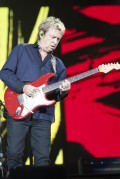

Sting has paid more than $800,000 to his former Police bandmates Andy Summers and Stewart Copeland after acknowledging historic underpayments, as a long running dispute over royalties moves through the High Court in London. Court filings confirm the payment was made after the guitarist and drummer launched legal proceedings last year against Sting and his publishing company, Magnetic Publishing.
The case centres on whether Summers and Copeland are entitled to additional income generated by downloads and streaming of The Police catalogue, a body of work that continues to earn significant revenue decades after the band’s peak commercial years. While Sting has accepted there were underpayments under earlier arrangements, he is disputing the wider claim that his former bandmates are owed a share of digital and streaming income.
According to documents lodged with the court, Summers and Copeland have received payments totalling more than £595,000, approximately $800,000 Australian, since the action began. Their legal team has confirmed the figure does not include interest, which they argue should be applied to what they describe as historic underpayment. The musicians’ lawyers have also indicated the overall claim could exceed £8 million if amendments to the case are allowed.
At the heart of the dispute is an agreement dating back to The Police’s formation in 1977. While Sting was the band’s principal songwriter and received the majority of writing credits, the trio allegedly entered an oral agreement to share a portion of publishing income when other members made significant creative contributions. This arrangement was later formalised in written contracts, including agreements updated in 1997 and again in 2016.
Under those terms, when one member wrote a song, the other two would typically receive around 15 percent of certain publishing income, often referred to as an arranger’s fee. Summers and Copeland argue that this understanding extended across all forms of exploitation as the industry evolved, including downloads and streaming, which have now replaced physical formats as the dominant mode of music consumption.
Sting’s legal team takes a different view. They argue that streaming should be classified as public performance rather than a sale and therefore falls outside the scope of the original arrangements. They also point to language in the 2016 agreement that limits royalty payments to income derived from the manufacture of records, a phrase they say applies to physical formats such as vinyl, CDs and earlier media.
The disagreement highlights a broader industry tension as legacy contracts are tested against modern distribution models. Many agreements written in the era of vinyl and cassette sales did not anticipate a future dominated by digital platforms, leading to disputes over interpretation and intent. Summers and Copeland’s lawyers are asking the court to consider the agreements in the context of these changes, arguing that the spirit of the original deal was to share income fairly as new revenue streams emerged.
None of the three musicians were present in court for the opening of the preliminary hearing. The matter is being overseen by Mr Justice Bright, with the current hearing focused on whether Summers and Copeland can amend their claim to explicitly include all streaming and download income. A full trial is expected at a later date.
The Police formed in London in 1977 and rapidly became one of the most influential bands of their era. Blending punk energy with reggae rhythms and sharp pop songwriting, they delivered a run of global hits including Roxanne, Message In A Bottle, Walking On The Moon and Every Little Thing She Does Is Magic. Their fifth and final studio album, Synchronicity, released in 1983, produced Every Breath You Take, a song that went on to become one of the most played recordings in radio history and a cornerstone of the band’s enduring commercial value.
Despite their success, internal tensions led to the group’s split in the mid 1980s. A reunion in 2007 and 2008 resulted in a highly successful world tour, though relations between the members remained strained. Since then, the catalogue has continued to generate substantial income, particularly through streaming services, where songs like Every Breath You Take have amassed billions of plays.
In 2022, Sting sold his songwriting catalogue, including material written for The Police, to Universal Music Group in a deal estimated to be worth around $200 million. That transaction has added another layer of complexity to the current proceedings, underscoring just how valuable the disputed revenue streams have become.
The High Court hearing is due to conclude shortly, with a decision on the scope of the case expected before a trial date is set. Whatever the outcome, the case is being closely watched across the music industry as a test of how legacy band agreements are applied in the streaming era.
🎟 Stewart Copeland Australia & New Zealand Tour – January 2026
Fri 16 Jan – State Theatre, Sydney
Sat 17 Jan – The Tivoli, Brisbane
Tue 20 Jan – Opera House, Wellington
Wed 21 Jan – Bruce Mason Centre, Auckland
👉 Tickets & Info: www.birdsrobe.com
Stay updated with your free Noise11.com daily music news email alert. Subscribe to Noise11 Music News here
Be the first to see NOISE11.com’s newest interviews and special features on YouTube. See things first—Subscribe to Noise11 on YouTube
Follow Noise11.com on social media:
Bluesky
Facebook – Comment on the news of the day