
Bad Bunny delivered a Super Bowl Halftime Show that placed Puerto Rican identity, heritage and unity at the centre of the biggest sporting broadcast in the world.
by Paul Cashmere
Bad Bunny’s Super Bowl halftime performance was staged as far more than a career milestone. It unfolded as a carefully constructed cultural statement, drawing on Puerto Rican symbolism, personal identity and a broader message of unity across the Americas. Performing on one of the most watched stages in global entertainment, Bad Bunny used every visual and musical choice to reinforce where he comes from and what he stands for.
Here is the full performance:
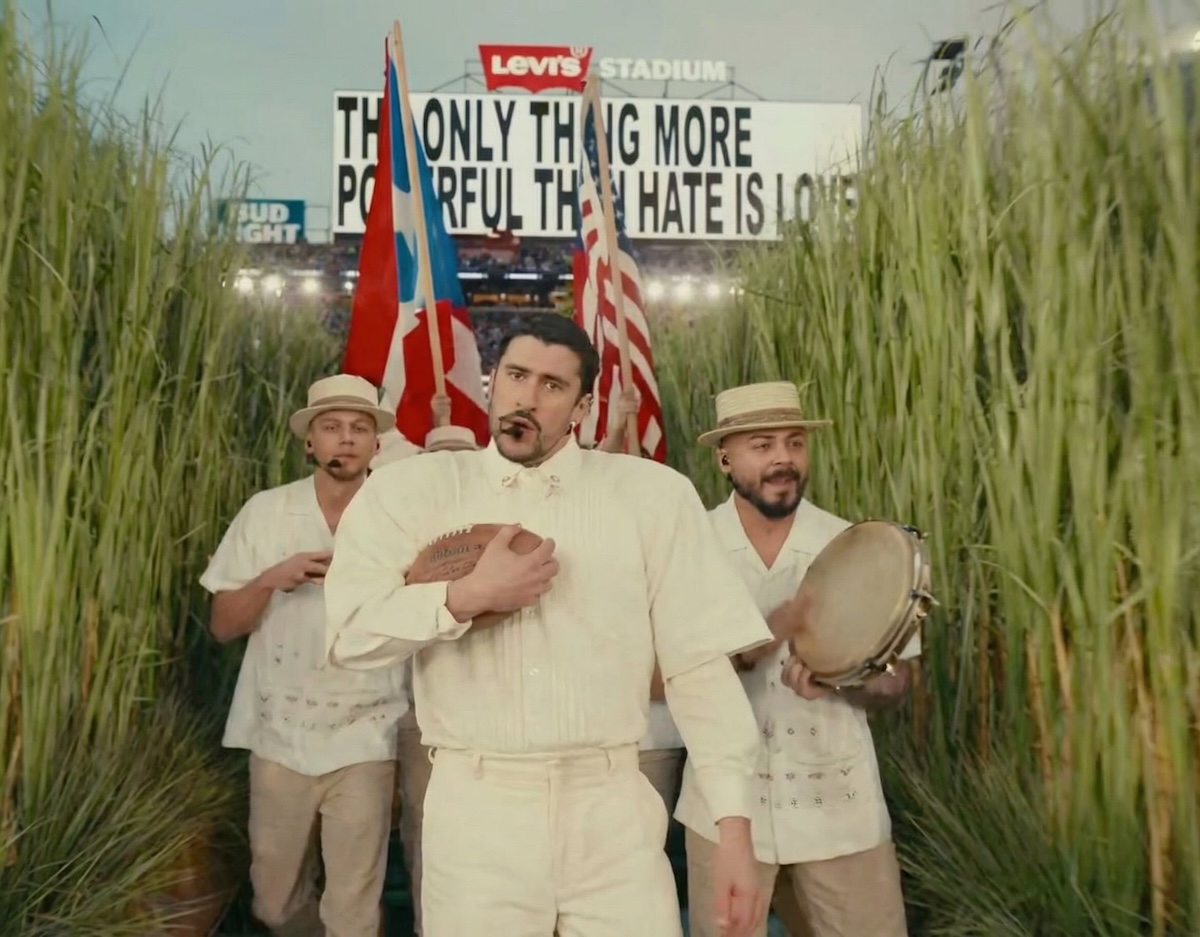
From the opening moments, the visual language was deliberate. Bad Bunny appeared wearing a traditional pava, the woven straw hat historically associated with the jíbaro, Puerto Rico’s rural farming class. The pava is deeply embedded in Puerto Rican history, originally worn by agricultural workers during Spanish colonial rule in the nineteenth century. Over time, the jíbaro evolved from a figure dismissed by colonial elites into a symbol of resilience and populist pride. In modern Puerto Rico, the pava has also taken on political meaning, representing resistance, cultural survival and self-definition.
Bad Bunny has incorporated the pava into his visual world before. It featured prominently in imagery surrounding his album Debí Tirar Más Fotos, and he brought an elevated version of the hat to the Met Gala in May 2025. Its appearance at the Super Bowl placed that symbolism in front of a global audience, aligning Puerto Rican history with one of America’s most powerful cultural platforms.
The performer later transitioned into an all-white football-style outfit that immediately ignited discussion. The jersey carried the name Ocasio and the number 64 across the back. While speculation online quickly attempted to link the reference to public figures, the meaning was far more personal. Bad Bunny’s full name is Benito Antonio Martínez Ocasio, and the jersey functioned as a public affirmation of his own identity, family name and heritage rather than an external political endorsement.
Throughout the performance, the staging reinforced a sense of everyday Latin American life. Bad Bunny moved past set pieces resembling a shaved ice stand and a taco stand, evoking familiar street-level scenes rather than spectacle for spectacle’s sake. The approach grounded the performance in lived culture, connecting millions of viewers to small, recognisable details from Puerto Rican and broader Latin communities.
The show also featured a wide range of guest appearances and performers, spanning generations and genres. Cardi B, Karol G and social media figure Alix Earle joined the celebration on stage, alongside actors Pedro Pascal and Jessica Alba. Later, the presence of Ricky Martin carried particular weight, linking Bad Bunny to a previous era of Puerto Rican global stardom and underlining the lineage he now extends.
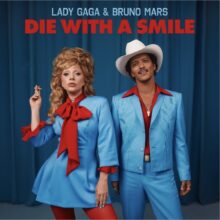
Musically, the halftime show expanded beyond standard pop production. A full horn section, trumpets, violinists and a conductor were integrated into the performance, adding orchestral texture and elevating the arrangements. Lady Gaga joined Bad Bunny for a striking collaborative moment on Die With A Smile, reworked to fit the scale and tone of the event. The combination of live instrumentation and guest vocalists gave the performance a cinematic quality without losing its cultural grounding.
Political messaging remained present but measured. Near the conclusion of the set, Bad Bunny addressed the audience in English, offering a blessing to America while broadening the sentiment to include all nations across North and South America. The moment reframed the idea of America as a shared hemisphere rather than a single country. A football held aloft carried the message Together We Are America, reinforcing themes of inclusion and collective identity.
Bad Bunny has a long history of engaging with political and social issues affecting Puerto Ricans and Latin communities, including immigration and government policy. Rather than delivering explicit slogans, the Super Bowl performance embedded those values through symbolism, language and representation. The closing visuals echoed this sentiment, with the stadium screens declaring that love outweighs hate as the final image of the show.
The performance concluded with Bad Bunny waving the Puerto Rican flag while balancing high above the stage infrastructure, a powerful visual metaphor for visibility, risk and pride. It was a defining Super Bowl halftime moment, one that fused pop spectacle with cultural storytelling, and positioned Bad Bunny not just as a global music star, but as a cultural ambassador for Puerto Rico on one of the world’s largest stages.
Bad Bunny Super Bowl setlist 8 February 2026
Tití me preguntó (from Un Verano Sin Ti, 2022)
Yo perreo sola (from YHLQMDLG, 2020)
EoO (from Debi Tirar Más Fotos, 2025)
Die With a Smile (Lady Gaga cover)
BAILE INoLVIDABLE (from Debi Tirar Más Fotos, 2025)
NUEVAYoL (from Debi Tirar Más Fotos, 2025)
El apagón (with Ricky Martin)(from Un Verano Sin Ti, 2022)
DtMF (from Debi Tirar Más Fotos, 2025)
Stay updated with your free Noise11.com daily music news email alert. Subscribe to Noise11 Music News here
Be the first to see NOISE11.com’s newest interviews and special features on YouTube. See things first—Subscribe to Noise11 on YouTube
Follow Noise11.com on social media:
Bluesky
Facebook – Comment on the news of the day