
Elvis Costello’s obscure 1970s demo “Jump Up” was never a hit, never a single and rarely played live, yet it became one of the most discussed songs of the final episode of Stephen Colbert’s Late Show. The track’s political satire, its unusual history and Colbert’s long-standing affection for the song explain why an overlooked recording resurfaced for television’s farewell moment.
by Paul Cashmere
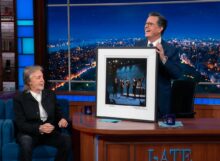
When Elvis Costello stepped onto the stage for the final episode of Stephen Colbert’s Late Show in New York on May 21, 2026, he did not reach for one of his best known songs. Instead, Costello performed ‘Jump Up’, a little-heard composition written roughly 50 years earlier, a song buried for decades in archive releases and known only to dedicated fans. The performance, featuring Colbert, former bandleader Jon Batiste and current bandleader Louis Cato, immediately prompted questions about why such an obscure track had been selected for one of television’s highest profile farewell broadcasts.
The answer lies partly in the song’s history and partly in the peculiar way political commentary can age. Written around late 1975 and early 1976, before Costello’s commercial breakthrough with My Aim Is True, ‘Jump Up’ existed during a formative period when the songwriter was still working out the themes and language that would later define his early catalogue.
Although the song predates My Aim Is True, it remained unheard by the wider public for years. It eventually surfaced as the “Honky Tonk Demo” on expanded editions of Costello’s debut album in 1993 and later again in 2001. Running for just over two minutes, it was recorded simply in Costello’s bedroom in London with nothing more than voice and guitar.
The song itself contains many of the lyrical fingerprints that would later become associated with Costello’s writing. The verses move through surreal imagery, observational humour and social unease, while political themes sit beneath the surface. Costello has described it as a commentary on campaign promises and election rhetoric placed within an invented landscape. Real anxieties were disguised through exaggerated and sometimes absurd language.
Lines such as “it’s a two-horse race and he changed his bets like it was just another brand of cigarettes” have taken on a longer life than Costello may have anticipated while writing them as a young songwriter in the mid-1970s.
That lyric appears to be central to Stephen Colbert’s connection with the song. Colbert has long admired ‘Jump Up’, not simply because of its obscurity but because of the way its observations still resonate decades after it was written.
The track’s themes of political opportunism, distrust of public promises and shifting allegiances have remained relevant through changing political cycles. The lyric, “Can’t trust the promise or a guarantee”, carries a universality that stretches far beyond the era in which it was first written.
For Colbert, who spent much of his television career using comedy and satire to examine politics and public life, ‘Jump Up’ represented something beyond nostalgia. The song reflects a scepticism that has remained present throughout his work, particularly during his years as a late-night host.
Costello himself barely performed the song publicly. Its live history is remarkably small considering the breadth of his catalogue.
The first known public performance occurred in November 2007 at a benefit concert at San Francisco’s Great American Music Hall with members of Clover, the California group that famously backed Costello during the recording sessions for My Aim Is True. The song resurfaced years later during solo appearances in Washington, Bexhill-on-Sea and Brussels.
Across nearly five decades, only five documented performances are known.
That scarcity gave the Colbert appearance additional significance. The Late Show performance effectively doubled as both a rediscovery and a celebration of a song that spent much of its existence hidden in archive collections.
There was also another layer to its placement in the programme. Following ‘Jump Up’, the farewell episode moved into a mass performance of The Beatles’ ‘Hello Goodbye’ featuring Paul McCartney. The contrast between the two songs was notable. Costello’s composition carried uncertainty and scepticism, while the Beatles classic delivered a communal sense of closure.
For Costello, the renewed attention may also prompt listeners to revisit the material that existed before My Aim Is True formally introduced him to the world. Hidden among demo recordings and alternate takes are songs that reveal a songwriter already examining many of the ideas that would define his later work.
‘Jump Up’ may have remained largely invisible for decades, but one final Late Show appearance placed it in front of an audience far larger than anything the song had experienced before.
Stay updated with your free Noise11.com daily music news email alert. Subscribe to Noise11 Music News here
Be the first to see NOISE11.com’s newest interviews and special features on YouTube. See things first-Subscribe to Noise11 on YouTube
Follow Noise11.com on social media:
Bluesky
Facebook – Comment on the news of the day